
6 Critical Success Factors for Manufacturing ERP Implementation

Enterprise resource planning (ERP) can be extremely challenging in all industries. However, a manufacturing ERP strategy can be even more complex. ERP failure in manufacturing comes in many forms. It’s usually a strategy and communication issue that requires a deeper understanding, rather than a software problem.
Organizations can overcome these problems by prioritizing data, processes, and people. But how can manufacturers ensure that they’re investing in ERP efficiently and for the most productive reasons? Here are 6 critical success factors for manufacturing ERP implementation that help to align systems and organizational strategies.
1. Strategic preparation
ERP implementation for manufacturers requires preparation. However, this preparation goes beyond choosing a launch date. Success is the goal, but what’s your definition of success? Decide the endpoint before implementing objectives. Doing so aligns pain points and business goals. For example, is reducing waste a goal for your entire company or for a specific business area?
This can be streamlined by building a dedicated implementation team. Assembling a group of stakeholders and leading voices across your IT, finance, and other operations ensures that all key workflow areas are considered. Having an executive sponsor in place helps break down obstacles in engineering, finance, and production.
Don’t forget that going live is a goal, not a destination. Sound strategic preparation looks beyond go-live to define measurable ERP metrics and targets that ensure long-term success.
2. Process alignment
Poor alignment can lead to a rigid ERP strategy in manufacturing. This leads to customizations that increase costs and undermine the original intent of unifying business processes. To get the most out of your investment, it’s important to reduce user frustration. Successful project alignment can also support decision-making in manufacturing processes.
To successfully align processes, businesses should:
- Map out processes to pinpoint inefficiencies and areas of improvement.
- Define where workflows require re-engineering rather than automation to meet industry expectations and leverage the ERP.
- Aim to unify processes across departments and business units through standardization.
- Establish a framework for constant process analysis and improvement to further align ERP and business needs.
Organizations should foster a culture of change. Employees and stakeholders need a chance to ask questions and receive detailed training to understand new processes.
3. Data integrity
A successful manufacturing ERP strategy depends on the data it receives. Poor-quality data leads to poor material requirements planning (MRP) and significant revenue loss. Having a long-term plan should give you months of data cleaning before an ERP is implemented. Make good use of this time and consider what data is worth migrating.
Consider areas where data accuracy matters most, such as bill of materials (BOMs), historical data, and routings.
4. User adoption
Human error is one of the main reasons for manufacturing and ERP planning failure. Investing in and implementing software is pointless if people bypass it or don’t understand it. A proactive change management strategy shows people how technology makes their jobs easier, rather than just telling them.
Users will better appreciate how the process affects their work and your organization’s work. This includes staff on all levels, including warehouse workers and manufacturing operators.
5. Rigorous testing
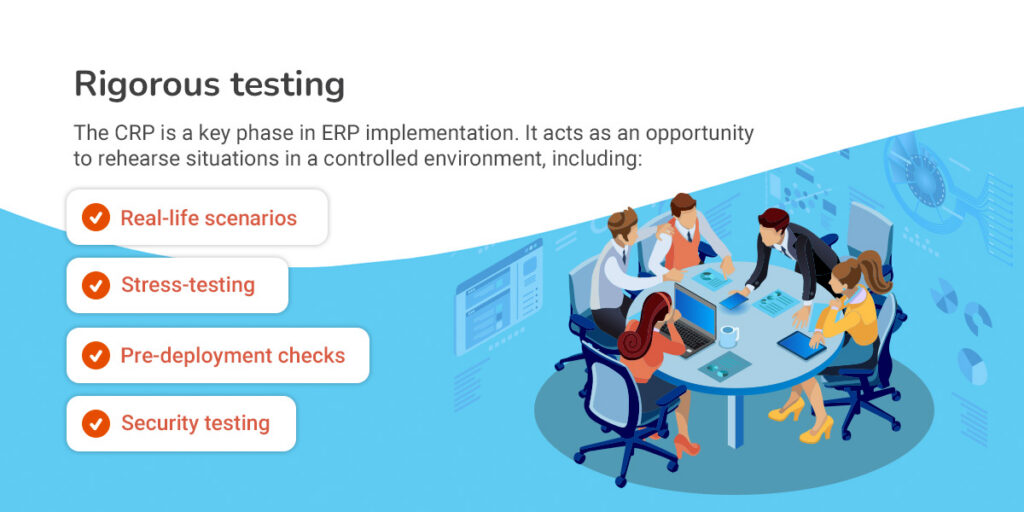
Organizations need to embrace robust testing measures. It’s what ensures theory and reality work in tandem during ERP implementation for manufacturers and their business requirements. The Conference Room Pilot (CRP) is a useful tool in creating the best possible manufacturing processes.
The CRP is a key phase in ERP implementation. It acts as an opportunity to rehearse situations in a controlled environment, including:
- Real-life scenarios: Testing that addresses real-day-to-day scenarios. This can include last-minute rush orders, machine breakdowns, and other potential problems encountered from end to end.
- Stress-testing: Ensuring the software can handle everything your organization throws at it. This includes data validation, functionality testing, and load testing to assess system capacity.
- Pre-deployment checks: Identifying integration problems, system design obstacles, and workflow issues before deployment.
- Security testing: Maintaining the correct access levels for stakeholders and ensuring compliance with data security and privacy.
Rigorous testing reduces the risk of inconsistencies and operational disruptions once your ERP is live. The more time and effort you put into testing, the lower the risk of undermining your investment.
6. Partner selection
Partnering with the right team of professionals is essential for efficient manufacturing and ERP planning. Having the right software and a specialist team isn’t something that’s negotiable in the manufacturing industry. General IT partners won’t offer the same level of understanding as a partner with experience in your industry’s complexities.
Look for partners with specific traits, such as industry-specific language and an understanding of standard costing. Consider your unique organizational requirements and find partners with a legacy of client success stories that align with those goals.
Creating a manufacturing ERP implementation checklist
With so many requirements for successful project scoping and data preparation, implementing ERP effectively can feel overwhelming. A clear list of priorities reduces this worry. A manufacturing ERP implementation checklist can keep organizational goals on track and aligned with shop-floor processes.
A robust manufacturing ERP implementation checklist should include:
- Clearly defined goals, key performance indicators (KPIs), and return on investment (ROI) expectations that all key stakeholders understand.
- Detailed information on existing processes, such as workflows and inventory, to identify gaps.
- Configured systems that match production workflows (unless stated otherwise) to reduce unnecessary customization.
- Systems that integrate easily with existing organizational systems.
- Training and communication that’s specific to the role each employee plays in ensuring success.
- User acceptance testing (UAT) of business-as-usual processes to locate gaps and potential issues before go-live.
- A realistic project budget and a clear timeline with foundational milestones planned out.
In manufacturing, ERP planning should also include post-live performance monitoring to measure success. It’s a never-ending process, and user feedback can help improve systems further.
Finding an experienced partner for manufacturing ERP success
The manufacturing industry can be one of the most confusing areas to implement an ERP system. Partnering with an experienced company that understands the pressures and goals within your industry can simplify your processes. ArcherPoint has been making work easier for our clients for over 23 years.
By empowering manufacturers to focus on their long-term mission, we help them make smarter business decisions. Our knowledge of Microsoft Dynamics 365 Business Central, Azure, LS Retail, and other platforms has supported organizations across North America, Europe, and Asia.
A strong manufacturing ERP is built on communication, learning, and the continual challenge of the processes in place. Doing so helps to improve business processes and ensure the strongest possible ROI.
Is your organization looking for an efficient, streamlined migration or upgrade? Be sure to contact ArcherPoint to learn more about how our implementation strategy can help.

Trending Posts
- Login Error: Communication protocol mismatch between client and server
- How to Make Measures Total Correctly in Power BI Tables
- The Microsoft Technology Stack – What Is It & Why Should You Care?
- MRP vs. MPS: Choosing the Right Planning Approach for Your Manufacturing Business
- Designing a Connected Student Engagement Technology Stack
Stay Informed
Subscribe to Communications
"*required" indicates required fields