
Where Grocery and Convenience Store Margins Really Go (and How to Take Them Back)

Margins in grocery and convenience retail are notoriously thin and getting thinner. Rising labor costs, inflation, supply chain disruptions, and shifting consumer behavior are putting increasing pressure on the profit margins of grocery and convenience stores. And competition from big-box retailers, dollar stores, and delivery platforms is intensifying.
Yet many operators find themselves in a frustrating position: Revenue is holding steady or even growing, but profitability is not. The reason is simple, but not always obvious. Margin erosion rarely comes from a single, dramatic failure. Instead, it leaks slowly across dozens of operational gaps, most small, many hidden, and nearly all difficult to isolate in real time.
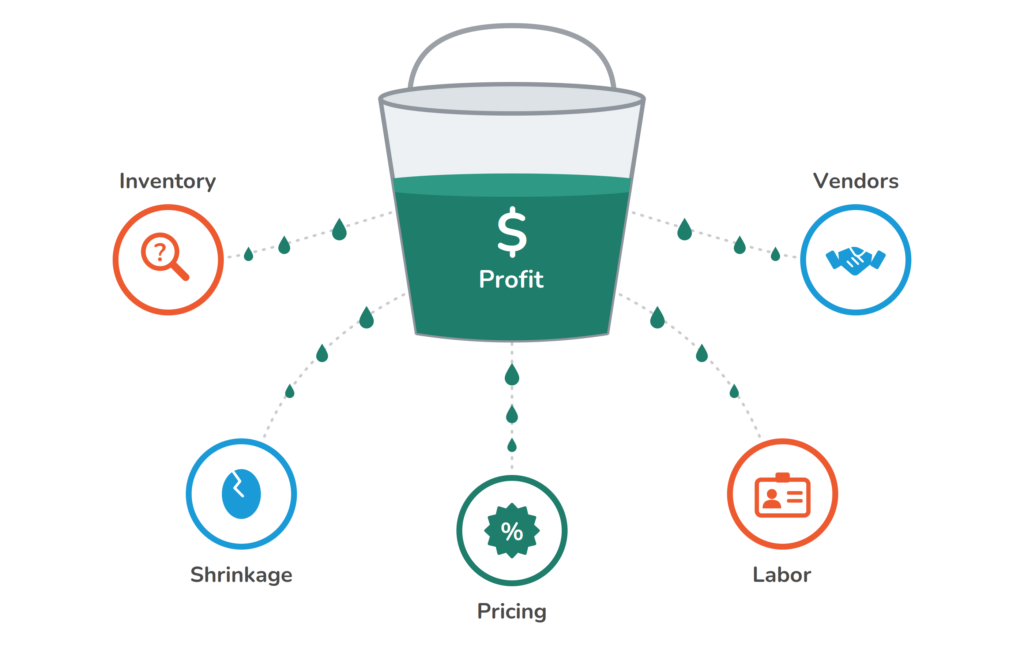
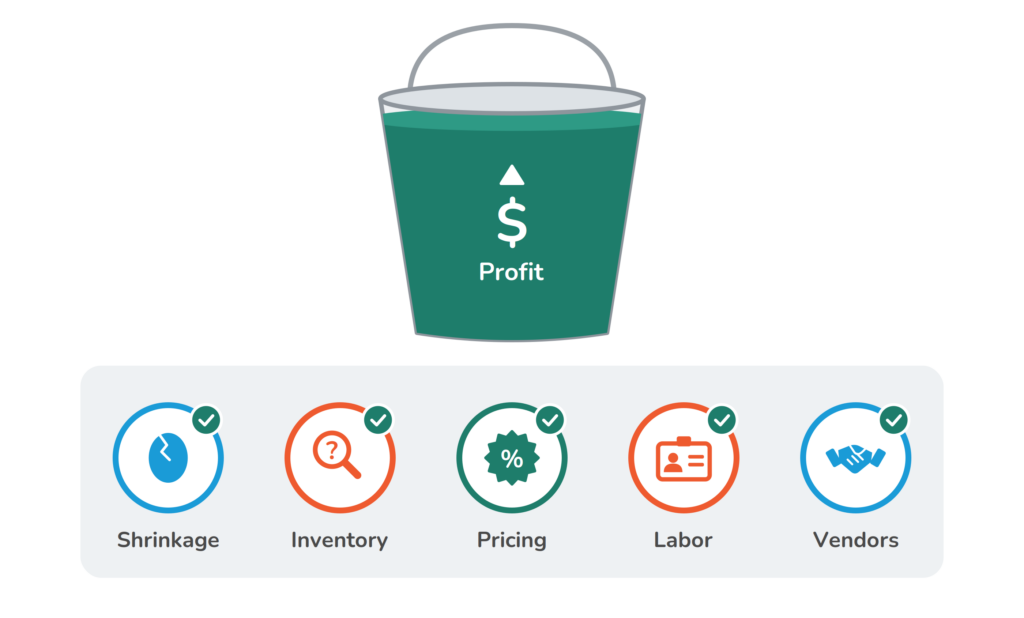
This is true for both grocery stores and convenience stores. While their business models differ (grocery stores operate at scale with broad assortments, while convenience stores focus on speed and high-margin items), the underlying challenge is the same: Margins are being lost in places most retailers aren’t fully equipped to see or control. Grocery and convenience store margins are typically lost across a handful of key areas. Five places retail margins disappear:
- Shrinkage → Spoilage, theft, damage, and errors
- Inventory → Overstock, stockouts, and inaccurate counts
- Pricing → Poor markdown timing and promotional decisions
- Vendors → Pricing discrepancies and missed rebates
- Labor → Staffing that doesn’t align with demand
Individually, these issues can seem minor. But in an industry where food retail profit margins averaged just 2.1% in 2025, small sources of leakage can have an outsized impact on profitability.
Why maintaining store profitability is harder than it looks
At a high level, many grocery and convenience retailers appear to be performing well: Sales are stable, promotions are driving traffic, and customers are still coming through the door. But profitability is lagging. Margin erosion is hard to address because it doesn’t show up cleanly in financial statements. It’s rarely a single line item that spikes or a single cost that suddenly increases; it’s a combination of small inefficiencies across shrinkage, inventory, vendor pricing, labor, and markdowns that accumulate until a profitable operation is merely surviving.
The deeper issue is timing: By the time most retailers recognize these problems, the margin impact has already occurred. What’s missing isn’t awareness; it’s visibility and the ability to act sooner.
With food retail profit margins averaging just 2.1% in 2025, even seemingly small sources of margin leakage can have an outsized effect on profitability.
Source: The Food Industry Association: Stats and Facts from FMI’s Signature Operations Benchmarking Report
Where grocery and convenience store profit margins are lost
Shrinkage is more than just waste
Shrinkage is one of the most visible and widely discussed sources of margin loss in retail. But despite the attention it receives, it remains one of the most persistent challenges.
In grocery stores, shrinkage is closely tied to perishables. Fresh produce, meat, dairy, and prepared foods are essential for attracting customers, but they also carry inherent risks. Demand can fluctuate significantly based on weather, local events, or even day-of-week patterns. Shelf life is limited, and small forecasting errors can quickly turn into unsellable inventory.
Convenience stores experience shrinkage differently, but it is just as impactful. While they carry fewer perishables, they still experience spoilage in categories such as sandwiches and ready-to-eat items. Theft and administrative errors can also play a larger role, particularly in high-traffic or extended-hour environments.
Shrinkage is especially difficult to manage because a single issue rarely causes it. It results from multiple factors interacting at once—forecasting inaccuracies, varying store practices, inconsistent tracking of expiration dates, and gaps in inventory visibility.
Most retailers measure shrinkage, but few truly understand it. Without clear insight into the root causes, efforts to reduce shrinkage tend to be reactive and short-lived.
Inventory imbalance: The cost of too much or too little
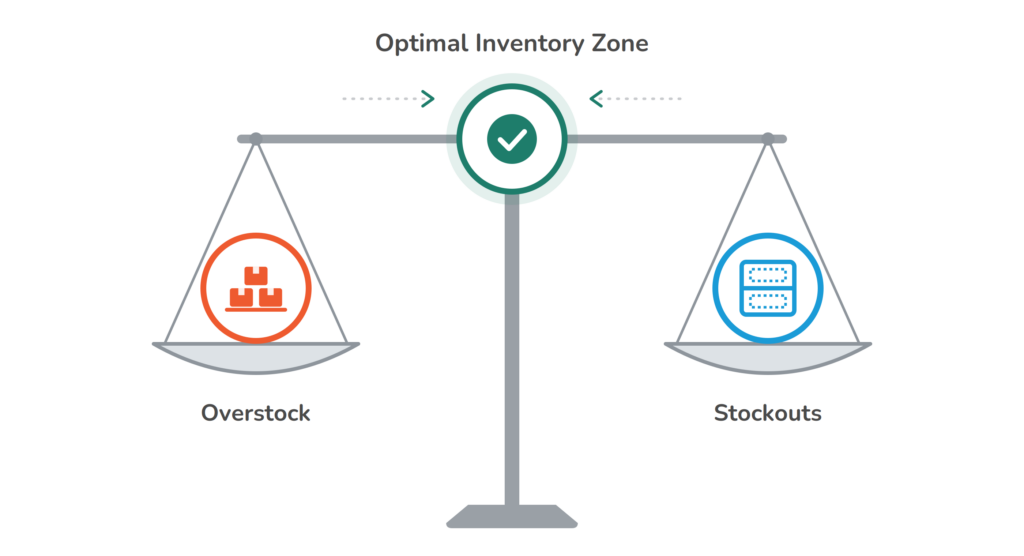
Inventory is where many margin challenges converge. Getting it right is one of the most important (and most difficult) tasks in retail.
Out-of-stock items are the most obvious symptom of an inventory imbalance. When customers can’t find what they’re looking for, the immediate loss is the sale itself. But the longer-term impact is often greater. Repeated stockouts can erode trust and prompt customers to switch to competitors.
On the other hand, overstock creates a different set of problems. Excess inventory ties up cash, consumes storage space, and increases the likelihood of markdowns or spoilage. In grocery stores, this is particularly risky for perishable items. In convenience stores, where space is limited, overstock can crowd out higher-performing products.
The challenge is that both conditions—too much and too little inventory—can exist simultaneously across different products and locations. Grocery retailers face this issue at scale, managing thousands of Stock Keeping Units (SKUs) with varying demand patterns and shelf lives. Convenience retailers operate with fewer items, but the impact of errors is magnified: With limited shelf space, every product must justify its presence.
In both cases, the root problem is the quality and timeliness of the data used to make decisions. When replenishment is based on outdated information or disconnected systems, inventory imbalances become unavoidable because decisions are made with inaccurate data.
Overstocking has a measurable price: U.S. food retailers generated 3.98 million tons of surplus food valued at $26.9 billion in 2024.
Source: ReFED–Food Waste by Sector: Retail
The complexity of pricing and markdown decisions
Pricing is a powerful lever in retail, but also one of the most difficult to optimize.
In grocery stores, pricing decisions are influenced by a wide range of factors, such as supplier costs, competitor pricing, promotional strategies, and product shelf life. For perishable goods, timing is critical: Mark down too early, and margin is sacrificed unnecessarily; mark down too late, and the product might not sell at all.
Convenience stores operate with a different pricing dynamic. Many items carry higher margins, but customers are also more price-sensitive than they might appear. A small price difference can influence purchasing decisions, especially when alternatives are nearby.
Markdowns, in particular, present a significant challenge. They are often applied reactively, based on what hasn’t sold rather than what is likely to sell. By the time a product is flagged for discounting, the optimal window to maximize value may already have passed.
The result is a pattern of missed opportunities, either as unnecessary discounts or unsold inventory. Retailers that perform well in this area take a more proactive approach, using data to anticipate demand and adjust pricing strategies to maximize profits.
Pro Tip: Markdown earlier, not just deeper. Start markdowns before the shelf life’s final day, then deepen them as expiration approaches. Don’t wait until closing time on the sell-by date to act.
Vendor management: The hidden costs that exist in plain sight
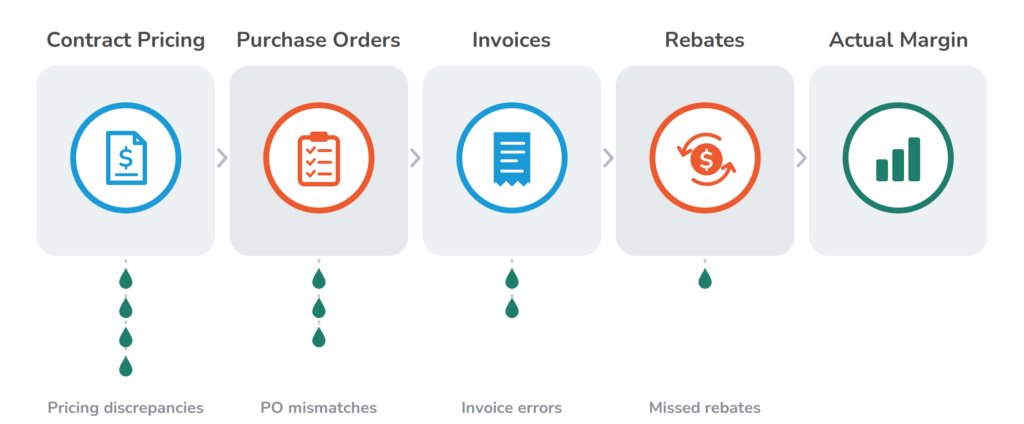
Behind every product on the shelf is a network of suppliers, contracts, and pricing agreements. Managing these relationships effectively is essential for protecting margins.
Vendor-related margin leakage often goes unnoticed because it’s buried in day-to-day operations:
- Pricing discrepancies between purchase agreements and invoices can go unnoticed
- Promotional allowances and rebates aren’t fully captured
- Terms might vary across locations, creating inconsistencies that are difficult to track
Grocery retailers, with their extensive supplier networks, are particularly exposed to these risks. And while convenience retailers often work with fewer vendors, they still face vendor challenges, especially when relying on a handful of distributors for a large portion of their inventory.
The issue is not just the complexity itself, but the lack of centralized visibility. When vendor data is scattered across systems or managed manually, it becomes difficult to identify and correct discrepancies. Over time, these small gaps can add up to a significant loss of margin.
Pro Tip: Regularly reconcile purchase invoices against vendor agreements, promotional allowances, rebates, and negotiated pricing rather than assuming every expected credit has been captured.
Labor: Balancing cost and experience
Labor is one of the largest expenses for both grocery and convenience retailers. It’s also one of the hardest to optimize. In grocery stores, labor demands are driven by a wide range of activities, from stocking shelves and managing fresh departments to handling deliveries and assisting customers. In convenience stores, staffing is typically leaner, but the need for extended hours and consistent coverage adds its own complexity.
The core challenge is alignment. Labor schedules are often based on historical patterns or manager intuition rather than real-time demand signals. This can lead to overstaffing during slower periods and understaffing during peak times.
The impact of proper staffing goes beyond cost. When staffing levels don’t match demand, the customer experience suffers: Lines get longer, shelves go out of stock, and employees become overwhelmed. Improving labor efficiency requires a deep understanding of how sales, traffic, and operations interact, along with the ability to adjust quickly as conditions change.

Curious how much these gaps are costing your business? Calculate your margin leakage with our free calculator and get a personalized estimate of how shrinkage, inventory, pricing, vendor, and labor issues are really affecting your bottom line.
Why data visibility is the key to retail margin optimization
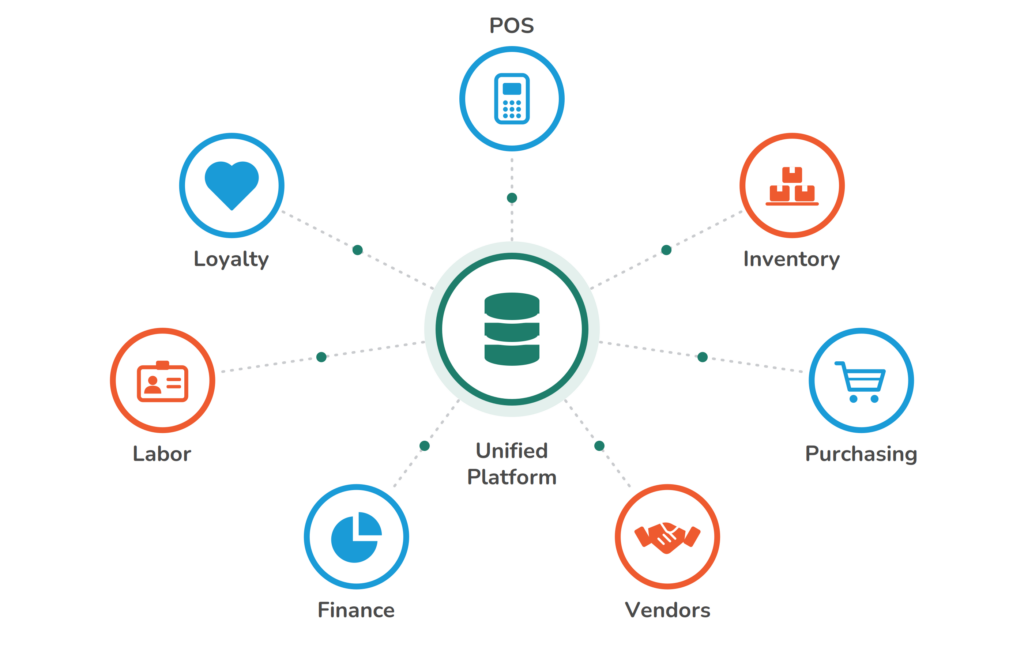
If one factor underlies all these challenges, it is the disconnect between the various business systems and the data they hold.
Most grocery and convenience retailers are not lacking in information. They have point-of-sale systems, inventory tools, accounting software, and more. The problem is that these systems often operate independently, each providing only a partial view of the business.
Store managers may rely on one set of reports. Finance teams may use another. Executives may see a consolidated view that lacks operational detail.
This fragmentation creates delays and inconsistencies, requiring manual intervention to consolidate the information and present it as a unified whole. By the time data is brought together and analyzed, the opportunity to act has often already passed. Improving grocery and convenience store profit margins requires more than simple data collection. It requires connecting systems, aligning information, and enabling faster decision-making across the organization.
Grocery vs. convenience stores: Different models, shared challenges
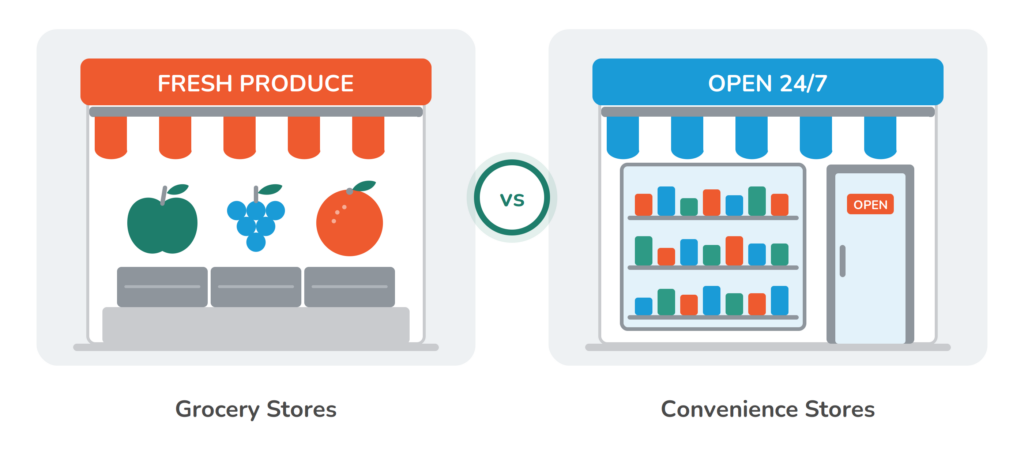
While grocery and convenience stores operate differently, their margin challenges are remarkably similar.
Grocery Stores
- Scale & complexity: Wide product assortment, multiple departments, and complex, multi-tier supply chains.
- Room for error: More SKUs and locations create more opportunities for small errors to compound.
- Operational focus: Improving forecasting, standardizing processes, and reducing variability across locations.
Convenience Stores
- Scale & complexity: Simpler, more focused assortment with fewer suppliers and formats to manage.
- Room for error: Limited space and speed mean every stocking or pricing decision has an immediate impact.
- Operational focus: Optimizing assortment, pricing, and execution at the individual store level.
Despite these differences, both types of retailers face the same fundamental issue: A lack of real-time, connected insight into their operations.

Ready to go deeper? Download the playbook, Grocery & Convenience Store Growth Without the Chaos,
to learn how standardized processes, connected data, and real-time visibility can help you grow with confidence.
How to improve grocery and convenience store profit margins
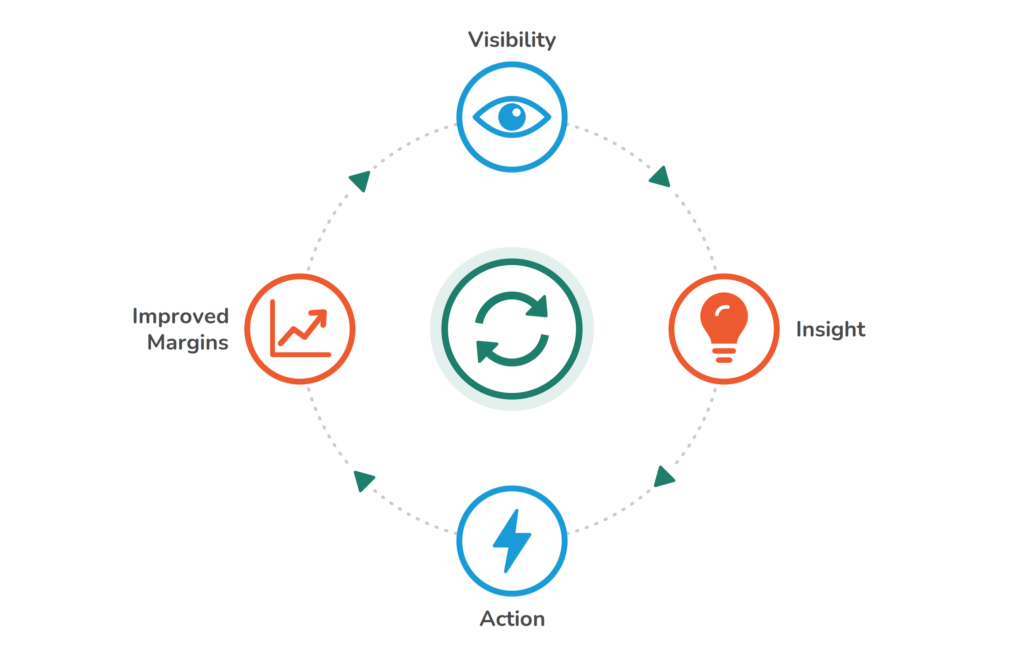
Build visibility, controls, and agility
Rather than addressing issues in isolation, retailers that improve margins focus on the underlying systems and processes that drive performance:
Build visibility → Connect sales, inventory, purchasing, vendor, labor, and financial data so leadership can see where margin performance is changing.
Strengthen controls → Establish consistent processes for inventory, markdowns, vendor pricing, rebates, and other areas where small discrepancies create recurring losses.
Increase agility → Use current data and exception reporting to identify unusual conditions and act before they become month-end margin problems.
This doesn’t eliminate the challenges, but it does let retailers anticipate issues and act before margins are affected, rather than reacting after the fact.
What a unified platform delivers
For many grocery and convenience retailers, achieving this level of visibility and control requires a more unified approach to their systems. LS Central, from LS Retail, is built on Microsoft Dynamics 365 Business Central and connects finance, inventory, purchasing, and retail operations in a unified platform. This gives you real-time visibility into where margins are being won or lost. With the right foundation in place, you can:
- Identify shrinkage trends earlier and take corrective action
- Balance inventory more effectively across locations
- Ensure vendor pricing accuracy and capture all rebates
- Align labor decisions with actual demand patterns
- Understand true store-level profitability in real time
- Integrate with scales, labels, and signage to automate price changes, descriptions, and bar codes
- Maximize loyalty and membership programs to encourage repeat business
Instead of reacting after margin loss occurs, you gain the ability to prevent it before it impacts your bottom line.
The payoff: Streamlined finance and room to grow
With that foundation in place, inventory, costs, and vendor relationships become easier to track and manage, based on current data rather than outdated reports, and financial processes become more streamlined, giving teams more time to act on data rather than gather it.
Perhaps most importantly, Business Central and LS Central provide a foundation for growth: As retailers add locations, introduce new product lines, or adapt to changing market conditions, they can do so with systems designed to scale.
“Our legacy system had a very loose way of connecting items, where they could become unhooked. We couldn’t trust the data.”
Mike DeMarco, Project Lead for Manufacturing Logistics at
MVR Cash & Carry
MVR Cash & Carry is a wholesale grocery distributor that rebuilt its inventory operations on Microsoft Dynamics 365 Business Central and LS Central. Read the full story: MVR Cash & Carry Builds a Connected Wholesale Distribution Platform to Deliver Exceptional Customer Service with Business Central and LS Retail
5 frequently asked questions about grocery and convenience store profit margin leakage
There’s no single cause. Shrinkage, inventory inaccuracy, pricing and markdown errors, vendor discrepancies, and labor misalignment all contribute, and the real problem is that these losses happen in different parts of the business and are hard to see collectively. Better visibility across inventory, sales, labor, and finance helps retailers identify where margin is being lost first.
Watch operational indicators that move before profitability does—rising shrinkage, increasing markdowns, declining inventory accuracy, frequent stockouts, and falling gross margin by category are common early warning signs. Dashboards and exception reporting can flag these changes as they happen, instead of waiting for month-end financials to reveal that margins have already slipped.
Start by identifying the actual cause—theft is only one source; spoilage, receiving errors, inventory count inaccuracies, and poor rotation often contribute just as much. Tracking shrinkage by department, category, and cause lets management focus on the highest-impact problems, while better inventory accuracy, expiration-date management, and receiving controls reduce losses without simply stocking less.
Key performance indicators (KPIs) worth tracking include gross margin by category, shrinkage percentage, inventory turns, markdown percentage, out-of-stock rate, and labor cost as a percentage of sales. The most valuable dashboards don’t just show these numbers in isolation—they surface relationships among them so leadership can investigate meaningful changes, not just individual data points.
Start with data, not assumptions—identify where gross margin is underperforming by store, department, or category, then examine the operational factors behind it, from inventory and shrinkage to pricing and vendor credits. Once the largest sources of leakage are identified, prioritize fixes by financial impact rather than trying to address everything at once.
Ready to stop the margin leak? Start here
If you’re ready to see exactly where your margins are leaking, request a Business Analysis from ArcherPoint by Cherry Bekaert: a no-obligation conversation about your specific inventory, pricing, vendor, and labor challenges.
Our Business Analysis will:
- Perform a step-by-step audit to pinpoint where your margins are leaking
- Identify security and compliance risks
- Help you simplify complex processes
- Provide requirements for the systems and technologies you need for long-term growth
Request your Business Analysis, and mention your grocery or convenience store operation when you connect with our team. Not ready to book a demo or have a meeting? Download our Grocery & Convenience Margin Leakage Calculator to get started.
Trending Posts
- Login Error: Communication protocol mismatch between client and server
- How to Make Measures Total Correctly in Power BI Tables
- The Microsoft Technology Stack – What Is It & Why Should You Care?
- MRP vs. MPS: Choosing the Right Planning Approach for Your Manufacturing Business
- Designing a Connected Student Engagement Technology Stack
Stay Informed
Subscribe to Communications
"*required" indicates required fields