
The Hidden Costs of Stockouts and How Business Central Can Help
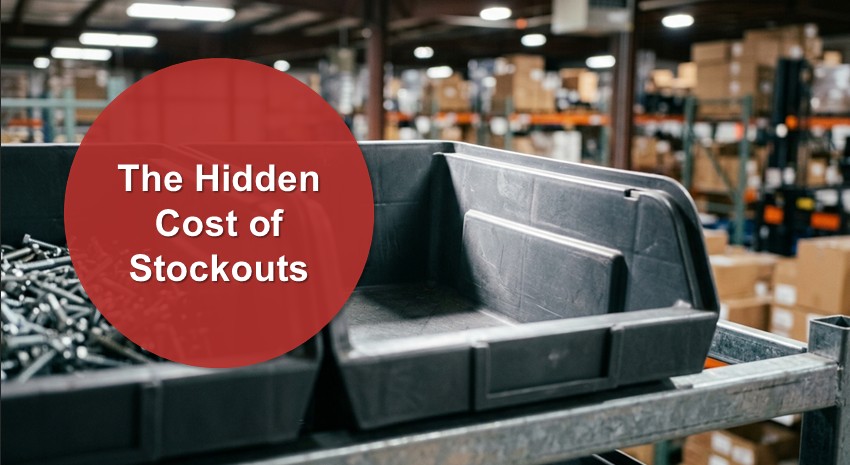
A stockout seems simple: a customer wants something, and you don’t have it.
The obvious cost is the lost sale. But for manufacturers, distributors, and retailers, the real cost rarely stops there. A single stockout can ripple into expedited freight charges, disrupted production schedules, inefficient purchasing, extra customer-service work, and excess inventory sitting in the wrong place elsewhere in the business.
It also chips away at something harder to quantify: customer trust.
What is the true cost of a stockout?
More than the margin lost on one missed sale. Add up the expedited freight, the purchasing concessions, the idle labor, and the customers who quietly start buying from someone else, and a stockout that looked like a minor fulfillment problem can cost thousands. Over time, recurring stockouts can affect both operational efficiency and profitability. The true costs never show up as a single line item.
The cost of stockouts in manufacturing, distribution, and retail
For a retailer, an empty shelf means a customer might substitute another product, postpone the purchase, or shop somewhere else. Repeated stockouts can undermine loyalty, create the perception that the store is unreliable, and drive customers to a competitor.
For a distributor, stockouts can lower fill rates and lead to partial orders, backorders, split shipments, and missed service-level commitments. The distributor might also have to absorb additional transportation and handling costs to make the customer whole.
For a manufacturer, the exposure is higher. Missing a single component or ingredient can interrupt an entire production schedule. Employees and equipment might sit idle while planners reshuffle production schedules, procurement searches for alternatives, and customer delivery dates are pushed back.
Stockouts increase purchasing and expedited freight costs
When the normal replenishment process can’t keep up, purchasing has to make tradeoffs fast: pay more to a backup supplier, cut order quantities, or give up negotiated terms just to get material in the door before the line stops.
Transportation costs can also be affected. A shipment that would normally arrive as part of a scheduled truckload might suddenly require expedited ground service or air freight. A distributor might split customer deliveries rather than wait until an order is complete. A manufacturer might expedite incoming components and then expedite the finished product to preserve the customer’s delivery date.
The sale might ultimately be saved, but much of its margin can disappear in the process.
The operational costs of stockouts
Some of the most expensive stockout costs never show up on an invoice at all.
Warehouse staff spend hours managing partial orders instead of processing new ones. Planners rework production schedules rather than run the next job. Finance handles the credits, rebills, and adjustments resulting from the scramble. None of that shows up as a line item, but all of it is capacity that could have gone toward something productive.
Manufacturers carry an added risk. When a shortage forces a schedule to be rebuilt around whatever components are actually available, the result is often shorter production runs, more setups and changeovers, and downtime or overtime later to catch back up.
How stockouts affect customer loyalty and retention
A consumer who repeatedly finds an empty shelf might begin shopping elsewhere. A retailer whose distributor routinely short-ships orders might seek another source. A manufacturer that can’t consistently meet delivery commitments risks becoming a less desirable supplier.
A single stockout probably won’t destroy an important customer relationship, but a pattern of them can.
That means the financial impact shouldn’t be evaluated solely as lost sales today. Leadership should also consider the potential effect on customer lifetime value, retention, fill rates, on-time delivery, and reputation.
What causes stockouts?
The immediate problem is “not enough inventory.” But that’s oversimplifying the problem.
Organizations can have too much inventory overall and still experience frequent stockouts.
The problem is having the wrong inventory in the wrong location at the wrong time.
The reasons for this are varied: Poor demand forecasting, unexpected demand spikes, inaccurate inventory records, supplier delays, long lead times, disconnected warehouse systems, production problems, and inadequate replenishment policies.
A common problem for multi-location businesses is that inventory is located somewhere in the organization, but employees lack sufficient visibility to find or reallocate it.
Why carrying more inventory doesn’t solve the stockout problem
Businesses usually respond to recurring shortages by increasing inventory, but that creates costs of its own.
Increasing inventory ties up working capital, requires warehouse space and handling, and increases carrying costs. Plus, excess inventory can risk obsolescence, markdowns, or spoilage.
Maintaining enough inventory to satisfy every conceivable demand scenario would be prohibitively expensive for most businesses.
Organizations must balance the financial consequences of a potential stockout against the cost of carrying additional inventory.
How better inventory visibility helps prevent stockouts
Preventing stockouts starts with understanding inventory within the broader supply chain.
Teams need to know not only what is on hand, but also what’s available to promise, what’s already committed to orders, what’s on purchase orders, what’s in production or transit, and when replenishment is expected.
They also need reliable demand information.
Connecting sales history, forecasts, inventory levels, supplier lead times, purchasing, and customer orders gives planners a much clearer picture of potential shortages before they occur.
The objective is to identify the risk while there is still time to act.
How Business Central can help reduce stockouts
Stockouts will never disappear completely, but you can make them less frequent and less expensive when they do occur.
Microsoft Dynamics 365 Business Central integrates inventory, purchasing, sales, warehouse operations, manufacturing, and finance into a common ERP environment, helping organizations visualize the relationships that drive stock availability.
Businesses can use demand forecasts, planning and replenishment tools, reorder policies, safety stock levels, lead times, and availability information to improve purchasing and production decisions. Inventory visibility across locations can also help organizations determine whether products can be transferred rather than purchased unnecessarily.
For manufacturers, Business Central connects material requirements with production planning, helping planners understand how component availability affects upcoming production. Distributors and retailers can use inventory and sales data to improve replenishment and gain better insight into products that are available, committed, or expected.
Because Business Central is part of the Microsoft ecosystem, organizations can extend that information through tools such as Power BI for dashboards and analytics and Power Automate for alerts and workflows.
Most importantly, finance and operations can work from the same underlying information. That makes it easier to evaluate the tradeoffs between inventory investment, service levels, purchasing costs, and profitability.
With Business Central serving as the operational hub, manufacturers, distributors, and retailers can identify potential shortages earlier and make better-informed decisions about how much inventory to carry and where to carry it.
Contact ArcherPoint by Cherry Bekaert to learn more about how Business Central can help your company manage inventory, improve forecasting, and minimize the impact of stockouts.
Trending Posts
- Login Error: Communication protocol mismatch between client and server
- How to Make Measures Total Correctly in Power BI Tables
- The Microsoft Technology Stack – What Is It & Why Should You Care?
- MRP vs. MPS: Choosing the Right Planning Approach for Your Manufacturing Business
- Designing a Connected Student Engagement Technology Stack
Stay Informed
Subscribe to Communications
"*required" indicates required fields