
Business Central for Discrete Manufacturing

Discrete manufacturers face constant pressure to ship on time, control costs, and meet customer expectations, but generic software causes disconnects and data silos across their operations.
Microsoft Dynamics 365 Business Central for discrete manufacturing helps close these gaps. It’s an integrated enterprise resource planning (ERP) platform built to manage discrete manufacturing operations at scale. This guide shows why discrete manufacturers outpace those using generic tools, how Business Central supports your workflows, and how to configure it for real operations.
Why discrete manufacturers outgrow generic accounting software
Most discrete manufacturers begin with basic accounting software. As needs grow, generic tools can’t:
- Track multilevel bills of material
- Manage engineering change orders
- Plan production capacity
- Support serial or lot tracking
- Calculate real-time inventory costs
- Coordinate purchasing with demand
These gaps lead to manual entries, out-of-sync inventory, and delayed reports. Many firms build “Frankenstein” systems by adding spreadsheets and point tools, introducing more risk.
In manufacturing, Business Central replaces fragmented tools with a unified platform that links transactions to operations. Each action updates financials in real time.
Why Business Central is the best ERP software for discrete manufacturing companies
Manufacturing requires real-time data, planning, logistics, and quality control. Business Central provides these core ERP functions on a cloud-based platform that scales with your business. Key manufacturing capabilities include:
- Bills of material with version control
- Routings for production steps
- Production orders and capacity planning
- Demand forecasting
- Serial and lot tracking
- Costing methods by item and operation
It integrates with Microsoft 365, Power BI, and Power Automate for reporting and workflow automation, also supporting compliance with audit trails, approvals, and role-based security.
Production bills of materials & routing
Bills of materials define what you build, and routings define how you build it. Both drive cost, lead time, and capacity. Business Central supports multi-level bill of materials (BOM), each level linking components, quantities, and scrap factors. You can model a three-stage assembly with subassembled and shared parts.
For example, a manufacturer builds control panels. Each panel includes a metal enclosure, wiring harness, terminal blocks, and fasteners. The wiring harness includes wires, connectors, and labels. Business Central tracks each level. A change to the wire gauge updates the cost and lead time for the finishing project.
Routing defines each step. You can assign work centers, setup time, run time, and queue time, linking each step to a work center. Each work center has a capacity per shift. Planners can spot bottlenecks when demand spikes.
This setup enables accurate cost tracking and lets managers compare planned vs. actual time by order.
Supply planning & automated replenishment
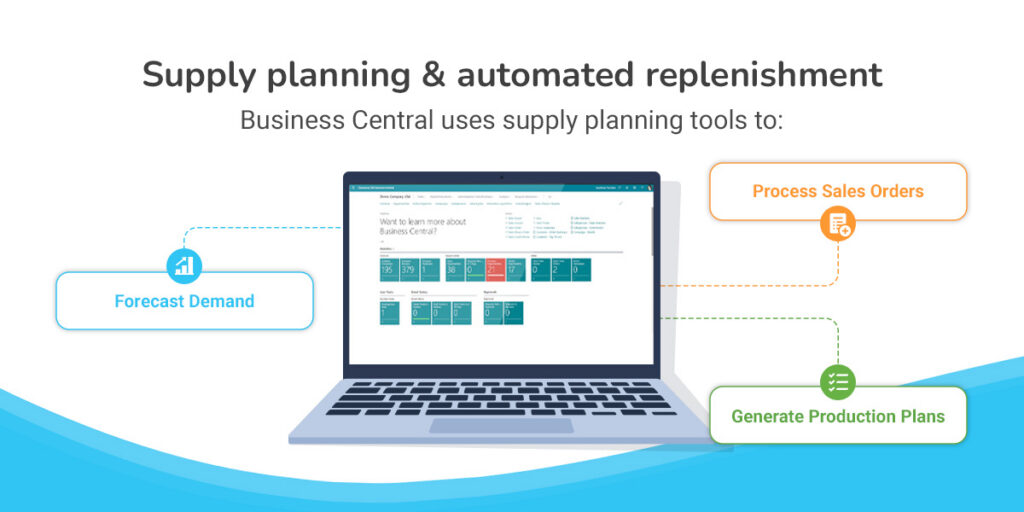
Planning fails when demand and supply data drift apart. Business Central uses supply planning tools to forecast demand, process sales orders, and generate production plans to drive replenishment. The system supports the material production schedule (MPS) and material requirements planning (MRP) logic. It considers lead times, safety stock, and lot sizes while generating suggestions.
For example, a valve manufacturer sets safety stock at 500 units for a brass fitting. Lead time is 14 days. When projected inventory drops below the threshold, Business Central creates a purchase suggestion for the buyer to review and release the order.
You can also automate reorder points for fast-moving parts. The system updates available-to-promise dates based on live supply, allowing sales teams to quote realistic dates.
Shop floor insight & capacity planning
Visibility drives performance, and Business Central tracks production orders, output, and consumption. Operators can post the time and the output for each operation. Supervisors see progress by work center, while planners see capacity load by day or shift.
For example, a CNC cell shows 120% load next week. The planner shifts low-priority work to a later date, and the change updates delivery dates alongside capacity plans.
You can track machine downtime, setup time, and scrap. These metrics feed continuous improvement, allowing leaders to spot chronic constraints and target fixes. Power BI dashboards extend insight, letting you view on-time completion, schedule attendance, and labor efficiency by plant.
Solving the “inventory puzzle” for discrete operations
Inventory is the largest working capital expense for most discrete manufacturers. Poor visibility ties up cash, stockouts halt production, and excess stock increases carrying costs. Inventory challenges include:
- Inaccurate in-hand counts
- Long lead times
- Demand volatility
- Obsolete parts
- Manual adjustments
How Business Central improves inventory control
Business Central supports lot and serial tracking. You can trace each component to each finished unit, traceability that supports quality, recalls, and compliance. The system also supports make-to-stock for standard items and assembly-to-order for configurable products.
Costing accuracy matters, as accurate costs support pricing. Business Central supports standard, first-in, first-out (FIFO), last-in, first-out (LIFO), and average costing. You can track material, labor, and overhead by order.
Benefits for discrete manufacturers
A unified ERP changes how discrete manufacturers operate. It replaces handoffs with shared data and aligns operations around a single system of record. This shift improves speed, accuracy, and accountability across the business. Key strategic advantages include:
- Faster quote-to-cash cycles: Sales teams see live inventory, capacity, and lead times. Quotes reflect real constraints, orders convert to production orders without reentry, and shipments trigger invoices in the same workflow.
- Better decisions at every level: Leaders view margins by SKU, customer, and channel. Planners can see schedule risk before potential delays, and buyers can see supplier lead-time drift in real time, allowing each stakeholder to make decisions that support the workflow.
- Lower operating risk: A single data model eliminates duplicate records and manual updates. Teams can work from the same item masters, BOMs, and routings, while finance closes faster with fewer adjustments.
- Growth without system sprawl: New plants, production lines, and channels use the same core platform. Teams avoid adding point tools that fragment data, delivering better capacity planning.
- Secure cloud access: Teams access the system from plants, offices, and remote sites. Updates can deploy without downtime, and security controls protect operational data.
Configuring Business Central for your unique workflow
Business Central works with thoughtful configuration. Start by mapping the process to document how orders flow from quote to shipment. Define all item structures, routings, calendars, and costing methods.
Training drives adoption. Train team members in their roles using live scenarios from your plant. Give buyers, planners, and operators short, task-based guides. Reinforce this with floor-level coaching during the first weeks of implementation.
ArcherPoint leads configuration efforts with the manufacturing context in mind. The team maps workflows before setup, consultants validate data models, and trainers focus on daily tasks that drive throughput.
Use Business Central for your discrete manufacturing
Discrete manufacturing grows more complex each year as margins tighten, lead times shrink, and fragmented systems slow response, raising risk. Business Central replaces silos with a unified ERP, allowing teams to act on shared data and leaders to see issues before they escalate.
ArcherPoint brings deep manufacturing experience, configuring Microsoft Dynamics 365 Business Central to match real-world shop-floor workflows through implementation and licensing. Our consultants guide data migration, training, and adoption with discipline. We have over 20 years of experience, 11 Microsoft competencies, and a commitment to our customers‘ growth. If you want faster quotes, tighter inventory control, and clearer production insight, take the next step.
Contact ArcherPoint by Cherry Bekaert to help you optimize your Business Central for discrete manufacturing.

Trending Posts
Stay Informed
Choose Your Preferences
"*required" indicates required fields