
From Scanner to Shelf: Fixing the Data Disconnect in Grocery and Convenience Stores
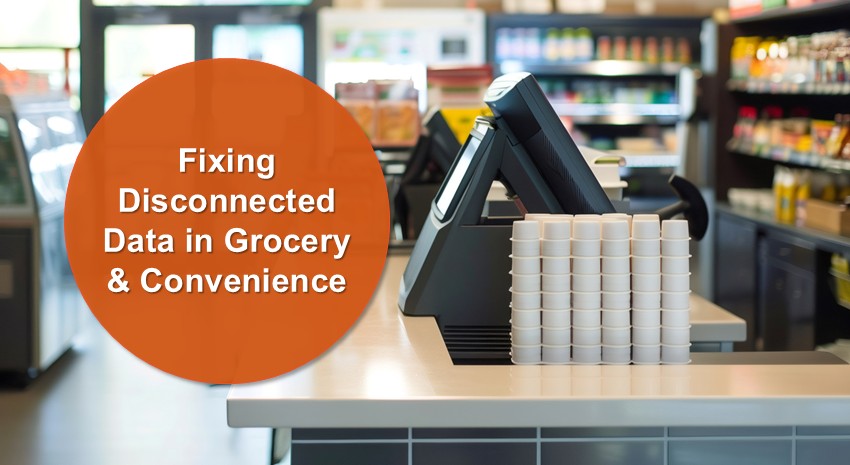
In grocery and convenience retail, every transaction tells a story: A product is scanned at checkout, inventory is reduced, and revenue is recorded. Afterward, a replenishment decision must be made, which might require that vendor orders need to change.
But in many organizations, that story gets lost somewhere between the scanner and the shelf.
The result? Decisions are made on incomplete, outdated, or disconnected data—and margins suffer.
If your organization feels like it’s constantly reacting instead of anticipating, the issue might not be your people or your processes.
It might be your data.
Why grocery and convenience store data gets disconnected
Most grocery and convenience retailers have no shortage of systems.
Point-of-sale systems track transactions. Inventory systems monitor stock levels. Accounting platforms handle financials. And spreadsheets fill in the gaps.
On paper, it looks like everything is covered.
In reality, these systems often operate in silos:
- POS captures sales but doesn’t always update inventory in real time.
- Inventory systems track quantities but might not reflect actual store conditions.
- Finance sees the numbers but often after the fact.
- Store managers must rely on experience because the data isn’t timely enough.
The result is a fragmented view of the business, where no one has a complete, real-time picture of what is really happening in the business.
And when that happens, even small disconnects can lead to costly outcomes.
How disconnected data affects store operations
The impact of disconnected data isn’t always obvious. Instead, it shows up across everyday operations:
- Out-of-stocks occur when inventory isn’t updated in real time. Inventory appears to be available but isn’t.
- Overstock builds up in back rooms in one location while other locations run short.
- Pricing decisions are made without full visibility into actual costs or demand trends.
- Vendor discrepancies go unnoticed until reconciliation, and by then it’s too late.
- Labor schedules are based on assumptions rather than actual traffic patterns.
The common element in each of these issues is data that isn’t connected, current, or actionable.
How delayed data contributes to margin leakage
In retail, timing is everything.
When data is delayed, even by a day, the consequences can compound quickly.
A fast-moving item goes out of stock because replenishment didn’t trigger in time. A perishable product isn’t marked down early enough and ends up as waste. Labor is scheduled based on last week’s patterns instead of today’s demand.
Individually, these issues may seem minor. But over time, they contribute to the same outcome: margin leakage.
This is why many retailers feel like they’re always one step behind: By the time the data is reviewed and decisions are made, the opportunity has already passed.
Why more retail reports won’t fix disconnected systems
A common response to these challenges is to invest in more reporting: More dashboards, more spreadsheets, and more data extracts.
But more data doesn’t solve the problem if the underlying systems remain disconnected.
In fact, it can make things worse, because teams spend more time gathering and reconciling information, and less time acting on it.
The issue isn’t the amount of data; it’s the lack of alignment between systems and the absence of a single source of truth.
What connected retail data actually looks like
Fixing the data disconnect doesn’t mean replacing everything. It means creating a more unified and integrated environment where information flows seamlessly across the organization.
In a connected retail operation:
- A sale at the register updates inventory immediately.
- Inventory changes can support automated replenishment.
- Vendor pricing can be validated against purchase agreements in real time.
- Financial data reflects operational activity without delay.
- Store managers and executives see the same information, tailored to their roles.
This kind of environment makes complexity more manageable.
Instead of reacting to issues after they occur, teams can spot trends early and act before they affect performance.
For retailers managing multiple locations, connecting data is an important step toward scalable growth. Our Grocery & Convenience Store Growth Without the Chaos playbook outlines six practical steps to standardize operations, create a single source of truth, improve inventory visibility, and maintain control as your store network expands.

Grocery vs. convenience: Different needs, same foundation
While grocery and convenience retailers share many of the same data challenges, their priorities can differ.
Grocery retailers often focus on improving coordination across departments and locations. Fresh inventory, forecasting accuracy, and supplier complexity require deep integration. For grocery stores, this challenge is amplified by scale. Thousands of SKUs, multiple departments, and complex supply chains make coordination difficult without unified data.
Convenience retailers, by contrast, operate in a more constrained environment. Speed and simplicity are critical. Decisions must be made quickly, often at the store level, with minimal margin for error. With limited space and fast-moving inventory, even small inaccuracies can have an immediate impact.
Despite these differences, both require the same foundation: Connected, real-time data that supports faster, more confident decision-making.
From insight to action
Many retailers already have the data they need.
The challenge is turning that data into action.
This is where the gap often widens. Insights may exist, but without the ability to act quickly—adjust orders, shift labor, update pricing—their value is limited.
Consider a product that is selling faster than expected at one store while sitting in excess inventory at another. A dashboard might reveal the imbalance, but connected systems and processes make it possible to act on that information by reviewing replenishment orders, transferring stock, or adjusting purchasing decisions. The value is more than simply knowing what is happening, it is being able to respond before the problem affects sales or margins.
Closing the loop between insight and action requires more than reporting and dashboards. It requires systems that work together, enabling decision-making and execution in real time.
How Business Central and LS Central connect retail operations
For retailers looking to close the data gap, the conversation often turns to technology—but not just any technology.
Solutions like Microsoft Dynamics 365 Business Central bring together finance, inventory, purchasing, and operations into a single, connected platform.
Pairing Business Central with a retail-specific solution like LS Central allows grocery and convenience retailers to:
- Provide more timely inventory visibility across locations.
- Align purchasing decisions with actual demand.
- Ensure vendor pricing consistency and capture all available rebates.
- Connect operational activity directly to financial performance.
- Reduce reliance on manual workarounds and spreadsheets.
Together, these technologies can help grocery and convenience retailers connect transactions at the register with the operational and financial information needed to run the business.
The first step: Understanding your gaps
Before you can fix the data disconnect, you first need to understand where it exists.
Where are decisions being delayed? Where are teams relying on manual processes? Where do discrepancies occur between systems?
These questions are often easier to answer when you start with a specific outcome, like margin performance.
If you can identify where margin is being lost, you can begin tracing those losses back to underlying data and process gaps.

Turn disconnected data into better retail decisions
Disconnected data creates blind spots that can lead to excess inventory, missed sales, unnecessary labor costs, and shrinking margins. The answer is ensuring your point-of-sale, inventory, purchasing, and financial systems work together so the information your teams rely on is accurate, timely, and actionable.
ArcherPoint by Cherry Bekaert helps grocery and convenience retailers build that connected foundation with Microsoft Dynamics 365 Business Central and LS Central. We help organizations connect store operations with back-office processes, improve visibility across locations, and turn operational data into better business decisions.
Ready to find out where disconnected data is costing you? Start with our Retail Margin Leakage Calculator to estimate potential losses across inventory, shrinkage, labor and vendor management.
Then connect with ArcherPoint by Cherry Bekaert to explore how an integrated solution can help you protect margins and support profitable growth.
Trending Posts
- Login Error: Communication protocol mismatch between client and server
- How to Make Measures Total Correctly in Power BI Tables
- The Microsoft Technology Stack – What Is It & Why Should You Care?
- MRP vs. MPS: Choosing the Right Planning Approach for Your Manufacturing Business
- Designing a Connected Student Engagement Technology Stack
Stay Informed
Subscribe to Communications
"*required" indicates required fields