
How Mid-Sized 3PL Providers Are Scaling Without Chaos in a High-Pressure Logistics Environment

Mid-sized third-party logistics (3PL) companies across North America are under unprecedented pressure. Customer expectations continue to rise, margins are tightening, labor remains unpredictable, and technology decisions feel riskier than ever. At the same time, many organizations are being asked to grow by adding new customers, services, and locations without disrupting operations.
Unfortunately, many 3PL companies are addressing the challenge of operating modern, high-speed logistics businesses on fragmented, aging systems and processes, resulting in more complexity, greater risk, and lost profitability.
Fragmented data: When systems don’t speak the same language

For most mid-sized 3PLs, the problem is not a lack of data. In fact, they often have too much of it. The problem is where that data lives. Logistics software systems, like Warehouse Management Systems (WMS), Transportation Management Systems (TMS), ERP platforms, CRM tools, inventory systems, and HR platforms, all generate valuable information. But many 3PL organizations implemented these systems at different times, for different reasons, and with different priorities. They were never designed to function as a unified ecosystem.
The result is data fragmentation, meaning no one system becomes the single source of truth. Fragmented data can adversely affect the company in different ways:
- Financial visibility is delayed or inaccurate
- Operational decisions are made without full context
- Customer reporting becomes inconsistent
- Growth introduces exponential complexity
When systems are not aligned, data must be reconciled manually. Outputs from one platform become inputs to another, often requiring human intervention to translate and validate along the way. The result is that these manual processes become necessary to move information from one system to the next, introducing delays, higher labor costs, and the possibility of human error.
Over time, the organization adapts—not by fixing the system, but by building workarounds. People become the connective tissue between systems. Spreadsheets fill the gaps. Institutional knowledge replaces system logic. What begins as a workaround becomes the company’s operational model. Modern logistics ERP systems facilitate automatic integration with warehouse management and transportation management systems, reducing or eliminating the need for manual intervention.

Why are so many 3PLs running on aging technology?
If the problem is so clear, why hasn’t it been fixed? The answer is not as simple as budget constraints. While cost is certainly a factor, the deeper issue is risk aversion rooted in operational reality. For many 3PLs, the current system, however imperfect, simply works. Orders move. Trucks ship. Customers are served. And revenue is generated. The fear is that new technology will break something that is currently working. This concern is not just hypothetical. A poorly implemented system can disrupt critical processes from dispatching to billing, creating operational slowdowns that ripple across the business.
This hesitation is reinforced by several realities:
- Past implementation failures have created skepticism among all levels of the organization
- Leadership and frontline operations are often misaligned
- Legacy systems have been heavily customized and are difficult to change or replace
- The cost of downtime is perceived as being more costly than the cost of inefficiency
There is also a human factor that often goes underestimated: Employees who have learned to navigate fragmented systems tend to resist change, not because they prefer inefficiency, but because they fear disruption, job loss, or loss of control. In this environment, doing nothing can feel safer than doing something. But over time, the cost of inaction only compounds as the company grows and systems become more complex.
The hidden cost of standing still: A TIMWOOD perspective
Aging systems do not erode margins all at once. Losses creep in gradually—through inefficiencies, missed opportunities, and increasing complexity. The TIMWOOD framework provides a useful lens for understanding this hidden cost. It identifies seven types of waste that exist in operational environments:
- Transportation
- Inventory
- Motion
- Waiting
- Overproduction
- Overprocessing
- Defects
In a fragmented 3PL environment, these wastes are not isolated; they are systemic.
Data must be manually transferred between systems (Transportation). Inventory discrepancies increase due to a lack of visibility (Inventory). Employees navigate multiple platforms to complete a single task (Motion). Decisions are delayed while data is gathered and validated (Waiting). Redundant manual processes emerge across systems (Overproduction and Overprocessing). Errors increase as manual intervention grows (Defects).
One real-world example highlights the impact: When a simple operational task requires multiple steps across disconnected systems, such as manually entering data from one system to the next, the additional minutes per transaction, multiplied by tens of thousands of similar transactions across the organization, add up to significant productivity loss without any corresponding revenue gain.
As a result, what started as a minor, inefficient process can gradually become the source of significant margin erosion as the company grows.
The labor challenge: The most immediate—and misunderstood—constraint
While technology fragmentation creates structural challenges, labor issues create immediate operational pressure. The unfortunate truth is that labor issues are often symptoms of process and system problems. Across North America, 3PLs are dealing with a combination of labor shortages, rising wage expectations, high turnover, and increasing skill requirements. Warehousing and logistics roles are physically demanding, often shift-based, and compete with other industries for the same talent pool.
At the same time, customer expectations continue to rise, requiring faster throughput, greater accuracy, and more flexibility. When labor is constrained, organizations might:
- Rush into automation without optimizing processes
- Rely on temporary labor to temporarily fill gaps, which can often lead to variable customer experiences
- Push existing employees harder, leading to decreased morale, low productivity, and burnout
- Introduce systems that employees are not prepared to adopt
Many organizations attempt to solve labor shortages by adding headcount or accelerating automation investments. This can create a dangerous cycle that often leads to reactive decision-making. There is also a cultural dimension. Employees who are not involved in process improvement or technology selection decisions are more likely to resist change. Conversely, organizations that engage frontline workers in continuous improvement efforts tend to see better outcomes, both in productivity and morale.

SQDCM in practice: Balancing performance across competing priorities
The SQDCM framework—Safety, Quality, Delivery, Cost, and Morale—provides a useful way to understand the interconnected pressures facing 3PLs. Customer demands primarily impact Delivery and Quality. Faster shipping, real-time visibility, and higher accuracy requirements drive operational intensity. But these improvements often come at a cost—literally and figuratively.
As labor strain increases, Safety can be adversely affected. Morale can decline if employees feel overburdened or disconnected from decision-making that directly affects their work. And Costs continue to rise without a commensurate rise in revenue.
Yet another dimension to the labor problem: In a fragmented environment, improvements in one area often create unintended consequences in another. For example, accelerating throughput without improving system integration with downstream processes can create bottlenecks or increase errors between the two systems. Reducing labor costs without addressing process inefficiencies can adversely impact service quality and employee morale. High-performing 3PLs recognize that these dimensions must be managed together, not in isolation.
Automation isn’t always the answer (at least not at first)
Faced with labor challenges and customer pressure, many 3PLs look to automation as the solution. And in many cases, automation can deliver meaningful gains in speed, accuracy, and throughput. But there is a critical caveat: Automation only amplifies processes; it does not fix them.
Automation works best when applied to clearly defined, repetitive tasks within a well-structured process. Without that foundation, automation can expose flaws rather than resolve them. One of the most common mistakes organizations make is attempting to automate a process that has not been fully defined or optimized. Without a clear understanding of the underlying process, these solutions can create more complexity rather than less.
When that happens:
- Bottlenecks become more pronounced
- Errors are replicated at scale
- Investments fail to deliver the expected ROI
The most effective organizations take a different approach: They define their baseline, optimize their processes, and then apply automation selectively where it delivers measurable value.
The cybersecurity risk no one can ignore
See the Cybersecurity for 3PL eBook for suggested attack surfaces: intrusion by external hackers, internal security gaps due to governance inconsistencies, staying current on software updates, etc.
As 3PLs become more digitally connected, cybersecurity becomes a core operational risk. Fragmented systems increase vulnerability by expanding the number of integration points and creating inconsistencies in data governance and auditability. Legacy platforms often lack modern security capabilities, while manual processes introduce additional exposure to human error.
At the same time, 3PLs are managing increasingly sensitive data, including customer contracts, shipment visibility, and pricing structures. A breach can disrupt operations, erode trust, and expose the organization to regulatory risks. Modern, integrated platforms reduce risk not only by improving security controls but also by simplifying the overall system architecture and administration.
The “Amazon Effect”: Rising expectations, flat margins
3PL companies are also facing a challenging dynamic: Customer expectations have fundamentally changed. The so-called “Amazon Effect” has redefined what customers expect from logistics providers: Faster delivery, real-time visibility, and seamless communication. So, while service expectations increase, pricing often remains constrained.
Organizations must find ways to deliver more value without a corresponding increase in revenue. This creates margin pressure that is difficult to offset through traditional cost-cutting measures. In many cases, the impact shows up as “hidden work”, additional tasks required to meet customer expectations that are not explicitly billed. These can include manual reporting, expedited handling, or exception management. Over time, these incremental demands erode the company’s profitability.
Growth without chaos: What high-performing 3PLs do differently
Growth is often seen as a sign of success. But in the 3PL industry, growth can expose underlying weaknesses in process, systems, and organizational alignment.
This is particularly true when:
- New customers introduce unique requirements
- Additional locations increase variability
- Systems struggle to scale
- Data becomes more fragmented
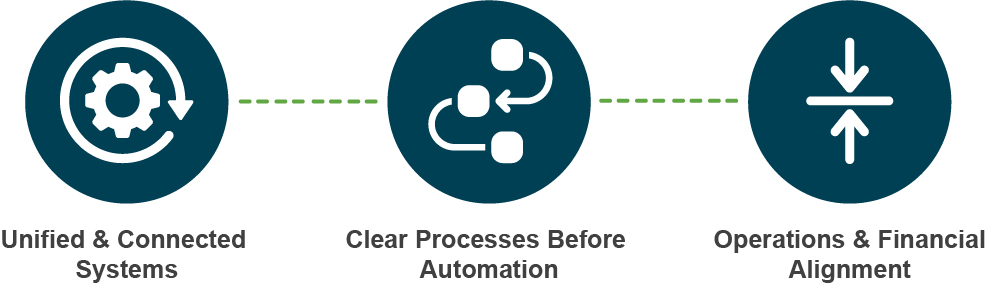
Without a structured operating model, growth can lead to chaos. The most successful 3PLs are the ones with the most aligned operating models. They focus on three foundational capabilities:
- Establish a clear system of record for data
- Integrate systems to reduce manual effort and improve accuracy
- Align operational activity with financial outcomes
This approach enables real-time visibility, more informed decision-making, and greater scalability.
The role of leadership: From technology decisions to organizational alignment
Technology initiatives often fail not because of the technology itself, but because of how they are implemented. Successful organizations recognize that transformation is as much about people and process as it is about systems.
These organizations make it a point to engage frontline employees to understand current operational processes, incorporate their input into system requirements, communicate clearly about how changes will affect them, and foster a culture of continuous improvement among all levels of the organization. Leaders who take this approach are more likely to increase employee adoption of new technology and processes, making the company better positioned to navigate complexity and drive sustainable improvement.
Ready to bring clarity and control to your 3PL operations?
Fragmented systems, aging technology, labor constraints, rising customer expectations, and margin pressure are converging to create a critical inflection point for 3PL companies. Those who rely on disconnected systems and reactive decision-making will continue to struggle to scale.
Growth should not come at the expense of visibility, control, or profitability. ArcherPoint works with mid-sized 3PL companies like yours to modernize operations, connect fragmented systems, and build a stronger foundation for scalable growth with Microsoft Dynamics 365 Business Central.
If you’re looking for logistics software, whether TMS, WMS, or an overall ERP that can handle everything, contact ArcherPoint by Cherry Bekaert to discuss how the right third-party 3PL software strategy can help your team reduce complexity and support the next stage of your business.
Trending Posts
- Login Error: Communication protocol mismatch between client and server
- How to Make Measures Total Correctly in Power BI Tables
- The Microsoft Technology Stack – What Is It & Why Should You Care?
- MRP vs. MPS: Choosing the Right Planning Approach for Your Manufacturing Business
- Guide to How Manufacturers Can Implement Quality Control Systems Using Business Central
Stay Informed
Subscribe to Communications
"*required" indicates required fields